
Empowering Bystanders: How to Save Lives During “Trauma Season” and Beyond
 In the critical minutes following a traumatic accident, the actions of a single bystander can mean the difference between life and death. While many people are familiar with CPR for cardiac emergencies, fewer know how to address the number one cause of preventable death after an injury: severe bleeding [1]. During the summer months—often referred to by medical professionals as “trauma season”—outdoor activities spike, leading to a significant rise in emergency room visits.
To combat this public health challenge, the American College of Surgeons Committee on Trauma administers the premier bleeding control training program known as Stop the Bleed [2]. In an educational interview on Midday Maryland, host Jonathan Marx sat down with David S. Shapiro, MD, a surgeon, trauma provider, critical care physician, and the Chair of the American College of Surgeons Committee on Trauma’s Stop the Bleed Program [3]. Together, they discussed the vital importance of emergency preparedness, how to identify a bleeding emergency, and the exact steps required to control bleeding before professional help arrives.
The Critical Gap: Why Immediate Response Matters
When a medical emergency involving severe trauma occurs, a person can bleed to death in as little as three to five minutes [1]. Even in areas with rapid emergency response, it often takes several minutes for an emergency medical technician (EMT) or paramedic to arrive on the scene. This delay creates a critical time gap where bystanders must act as immediate responders.
The Stop the Bleed campaign was originally initiated by a federal interagency workgroup convened by the National Security Council Staff at the White House [4]. This collaborative effort was led by the American College of Surgeons to bring the lifesaving lessons of military medicine back to the civilian homeland [4]. During the conflicts in Iraq and Afghanistan, advances in hemorrhage control and military trauma care demonstrated that early tourniquet application and wound packing significantly increased survival rates [5]. Today, the campaign translates these military breakthroughs into public knowledge, establishing national resilience and promoting injury prevention [4].
How to Use a Tourniquet: A Step-by-Step Guide
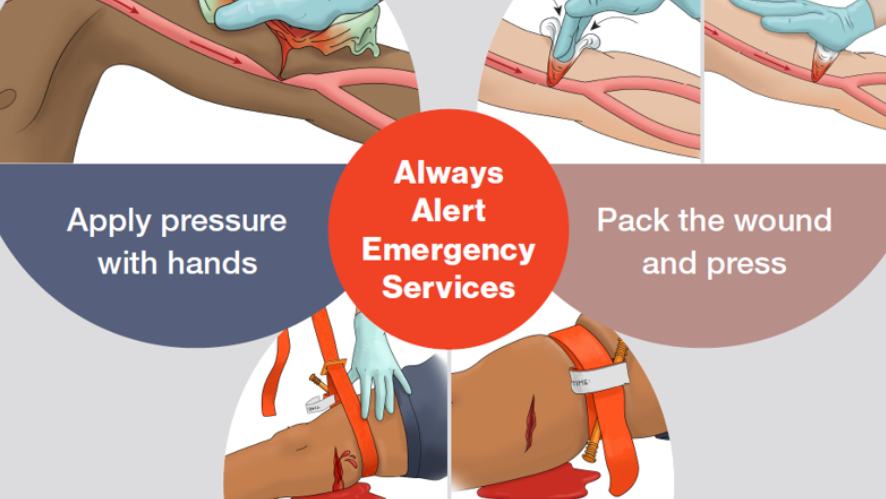 Understanding how to use a tourniquet is one of the most powerful skills in first aid and disaster preparedness. Despite historical misconceptions, modern clinical data proves that a tourniquet is a safe and highly effective tool for temporary hemorrhage control [5].
Here is the correct procedure for how to use tourniquet devices (specifically the Combat Application Tourniquet, or C-A-T, which is featured in official kits) [3] [6]:
- Place the Tourniquet: Position the tourniquet around the bleeding limb, approximately 2 to 3 inches above the wound. Do not place it directly over a joint (such as the knee or elbow); if the wound is near a joint, place the tourniquet above the joint. If the exact source of the bleed is unclear, apply it “high and tight” on the limb.
- Pull the Strap: Pull the self-adhering band as tight as possible through the buckle and secure it back on itself.
- Twist the Windlass: Twist the windlass rod until the bleeding stops and the distal pulse is no longer felt. Note that tourniquet application can be highly painful for the victim, but it is necessary to save their life.
- Lock the Rod: Secure the windlass rod inside the clip to keep it from untwisting.
- Record the Time: Write the exact time of application on the tourniquet’s time strap using a permanent marker. This is vital information for the emergency medical technician and trauma surgeons who will treat the patient later.
What is Inside a Trauma Kit?
For comprehensive emergency preparedness, keeping a dedicated trauma kit in your home, car, and backpack is highly recommended. During his appearance on Midday Maryland, Dr. David S. Shapiro, MD unboxed a standard bleeding control kit and demonstrated its contents [3].
Unlike a standard first aid kit that contains adhesive bandages and antiseptic wipes, a specialized bleeding control kit contains medical-grade supplies specifically curated to stop bleeding from severe trauma [3]:
- Cohesive/Protective Gloves: To protect the responder from bloodborne pathogens.
- Compressed Gauze: Highly absorbent sterile gauze used for wound packing and applying direct pressure.
- Trauma Shears: Heavy-duty scissors capable of cutting through thick clothing, leather, or seatbelts to expose the wound.
- Permanent Marker: Used to write the time of tourniquet application.
- C-A-T® Tourniquet: A military-grade windlass tourniquet approved by the Committee on Tactical Combat Casualty Care.
- Instruction Manual: A quick-reference guide detailing the core steps of the program.

